

StimPack Policy Papers
Part II: Survey-Based Recommendations for Haiti's Economic Restart
The second paper in a two-part StimPack series: a practical implementation sequence based on operator and investor survey input.
- #Haiti
- #Economic Development
- #Policy Recommendations
- #Customs Reform
- #Infrastructure
Part I diagnosed the structural trap: thin fiscal base, distorted trade channels, fragile market infrastructure, and short confidence horizons.
This paper answers the next question: what should be done first, by whom, and in what order?
Read Part I: Diagnosing Haiti's Economic Trap After Level-One Security
What the survey was built to capture
The survey was designed for implementation, not commentary. Respondents were asked to identify the first moves that would change operating behavior in the first 12 to 24 months of a credible security opening.
Across respondents, one pattern stood out: recommendations clustered around a narrow set of bottlenecks that simultaneously affect revenue integrity, legal competitiveness, and restart speed.
That convergence is useful. It means policy can prioritize a short list and execute deeply instead of announcing broad agendas with shallow follow-through.
Recommendation 1: rebuild customs as a credibility system
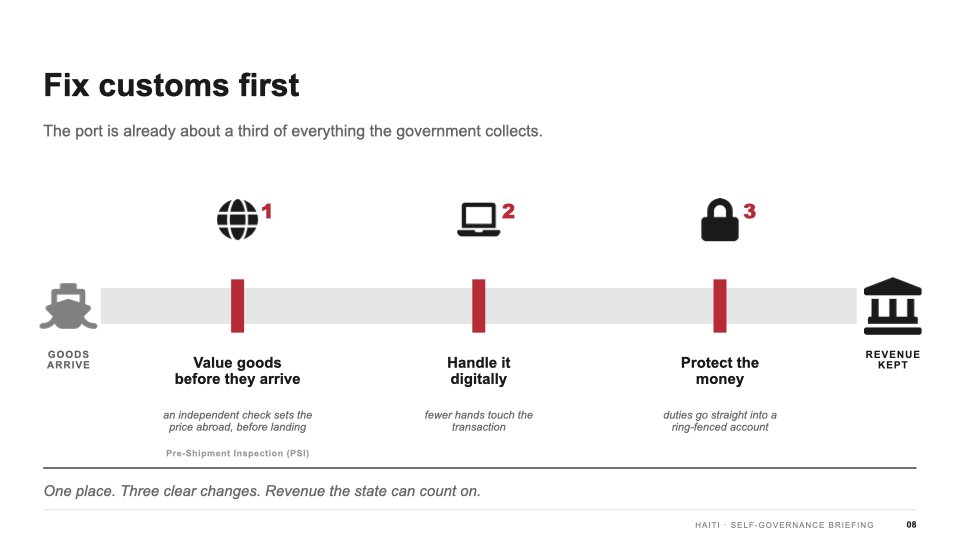 Figure 1. Customs reform stack: pre-shipment valuation, digital handling, and ring-fenced duty flows.
Customs reform should be treated as a credibility system, not a technical patch.
The minimum viable architecture has three layers:
- Pre-shipment valuation to reduce invoice gaming before arrival.
- Digitized processing to reduce discretionary choke points.
- Ring-fenced duty flows with auditable reporting.
This does two jobs at once: improves collection quality and reduces the structural penalty imposed on compliant operators.
A non-negotiable safeguard: any external concession model in customs must be fully transparent and legally bounded. Revenue authority cannot be quietly privatized through opaque long-duration contracts.
Recommendation 2: close bypass corridors that neutralize port reform
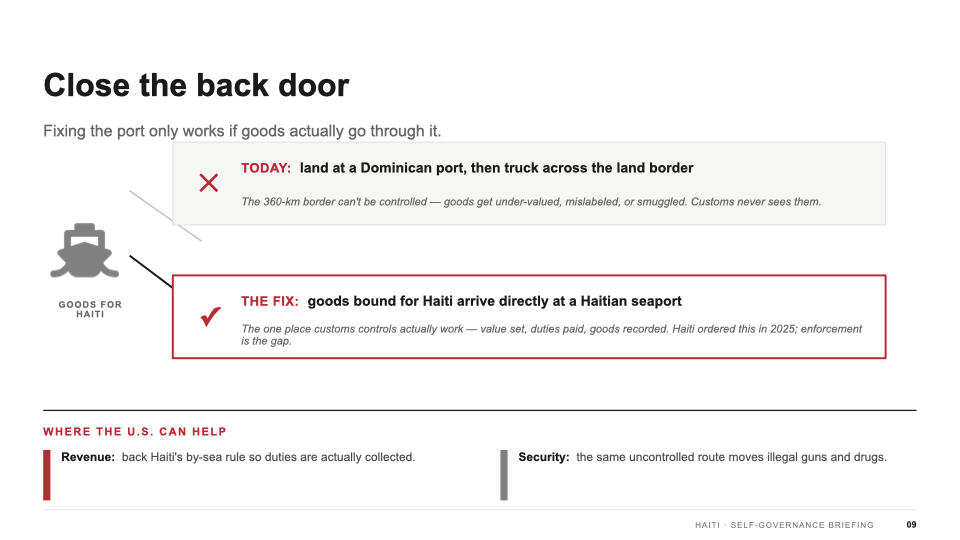 Figure 2. Border/port routing logic and enforcement implications for revenue and security.
Port reforms fail when bypass pathways remain open.
For Haiti, this means customs modernization has to be paired with corridor and border enforcement that prevents systematic diversion of commercial flows into weak-control channels.
This is one of the few policy areas where fiscal and security objectives are naturally aligned:
- protect legal commerce,
- improve duty integrity,
- and reduce room for coercive rent extraction.
Recommendation 3: build power around payment-assured demand
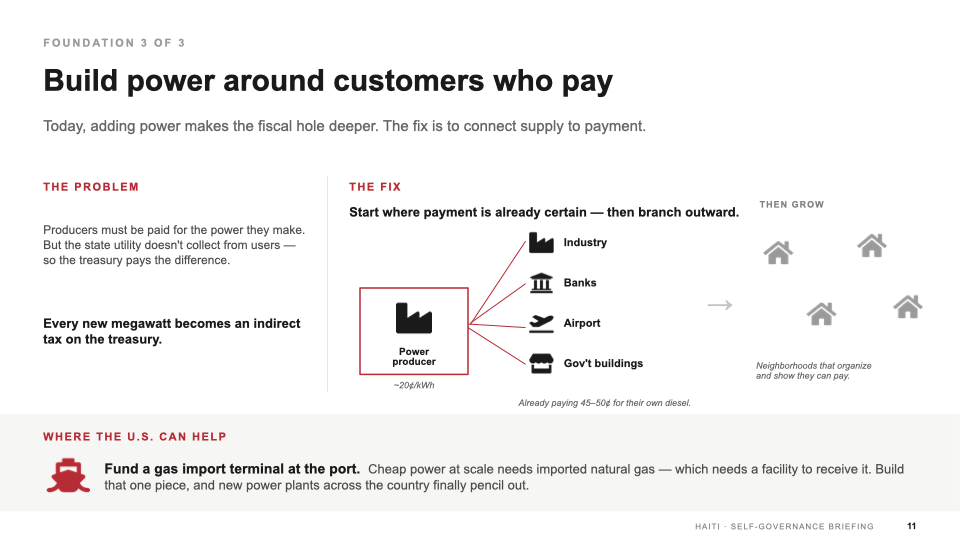 Figure 3. Payment-assured power architecture and enabling import logistics.
Power strategy should start where payment discipline already exists. That typically means industrial facilities, financial institutions, logistics nodes, and critical public complexes that can sustain contractual payment behavior.
The logic is financial before it is ideological: begin where cash flow can carry service reliability, then expand outward in stages.
Attempting universal recovery from day one usually recreates deficits before reliability is restored.
Recommendation 4: treat cash logistics as core recovery infrastructure
Survey responses were consistent on this point: cash-distribution reliability is an economic stabilizer.
Where upstream cash movement into secondary markets fails, transaction velocity drops, remittance usability degrades, and local trust in formal channels falls.
The near-term program should include:
- secured cash logistics to regional hubs,
- liquidity buffers for branch and agent networks,
- parallel expansion of digital rails where adoption is already viable.
Digital channels are part of the fix. They are not an overnight substitute for cash in all corridors.
Recommendation 5: restart proven operators before betting on greenfield scale
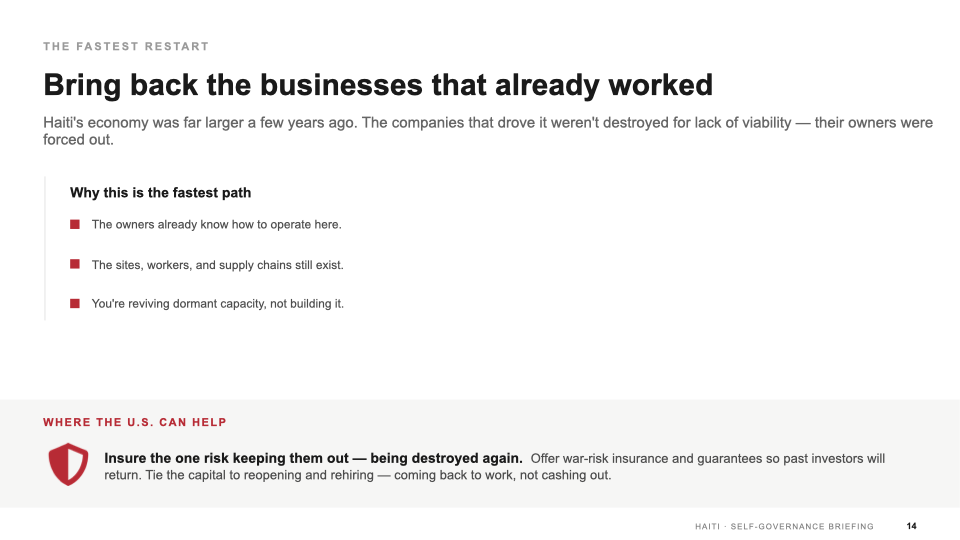 Figure 4. Fast-restart concept: reactivating existing firms with de-risking tied to rehiring.
The fastest way to recover output is often to reactivate firms that already proved they can operate.
These firms usually retain supplier memory, workforce pathways, and execution routines. What blocks reopening is usually risk asymmetry, not technical incapacity.
A practical de-risking package can combine:
- partial guarantees tied to reopening milestones,
- political and war-risk coverage linked to verifiable compliance,
- co-investment structures with clear guardrails against passive rent capture.
Recommendation 6: sequence politics and economics to preserve confidence
Economic restart policy has to account for political timing risk.
When election milestones move faster than administrative and territorial readiness, investors and operators shorten commitments and hold back reinvestment.
A better approach is benchmark-linked activation:
- define measurable readiness thresholds,
- release program phases against verified milestones,
- maintain transparent reporting on compliance and delays.
This protects both credibility and capital formation.
A 12-24 month execution sequence
A practical sequence, based on survey convergence, looks like this:
- Stand up customs integrity architecture and transparency controls.
- Pair customs reform with corridor enforcement to suppress diversion channels.
- Launch payment-assured power restoration in high-leverage nodes.
- Stabilize cash logistics and liquidity distribution in priority corridors.
- Deploy de-risking instruments for proven operators tied to reopening and hiring.
- Expand phase-by-phase based on measured compliance and market response.
This is intentionally narrow. Focus is a feature, not a limitation.
What success looks like in the first phase
The first phase is working when behavior changes, not when documents are published.
Early indicators should include:
- measurable reduction in valuation and clearance anomalies,
- improved legal importer competitiveness,
- increased reliability in targeted power nodes,
- restored liquidity continuity in selected regional corridors,
- verified reopening and hiring by dormant firms under de-risking programs.
If these signals do not appear, the program is not yet operational, regardless of rhetoric.
Closing
Haiti does not need another broad promise architecture. It needs an execution architecture.
The survey points to a disciplined sequence where each move reinforces the next. Start with the bottlenecks that shape daily economic behavior, publish auditable results, and expand only when trust is earned in operation.
That is how a short security opening can become a durable economic restart.