
Policy Chapter
After Level-One Security: The Fiscal Case for Restarting Haiti's Real Economy
A long-form strategic chapter based on Jeff Frazier's June 2026 presentation, interview set, and Haiti Working Group findings on customs, fiscal capacity, diaspora capital, and practical economic restart policy.
- #Haiti
- #Economic Development
- #Fiscal Policy
- #Customs Reform
- #Diaspora Investment
- #Security and Governance
Haiti will not stabilize by force alone. Security operations may suppress immediate threats, but they cannot fund a state, restore dignity, or absorb young men currently priced into violence. If the guns quiet down and jobs do not follow, the same structural pressures will regenerate the same disorder.
That is not theory. It is the central message that emerged from our June 2026 work: from the Haiti Working Group meeting, from the business interviews that informed my presentation, and from direct operational evidence across customs, energy, finance, and trade. This paper consolidates that evidence into one strategic argument: Haiti's next phase requires parallel economic statecraft, not sequential policy delay.
The first question
If Haiti reaches what we called level-one security, where major corridors reopen and an elected government can function, what should the United States and international partners do first to prevent a full relapse?
The wrong answer is to treat economics as a later chapter. The right answer is to treat economics as part of the security architecture itself.
But before we pretend this is linear, we should be honest about disagreement inside the operator set. One manufacturing operator running under daily security pressure was blunt with me: if elections are rushed under partial security, Haiti could get a formal transition without functional legitimacy. The warning was not abstract. It came from daily operations inside a coercive economy where corridor access still carries gang rents.
So this paper does not assume a clean handoff from security to politics to growth. It assumes messy overlap. That is exactly why the economic track cannot wait.
Slide-by-slide fiscal case (talk track)
The June deck was built to do one thing clearly: move the conversation from slogan to arithmetic. Not from aspiration to despair, but from loose language to hard sequence. This section follows the deck in presenter order and carries the argument as I would deliver it live.
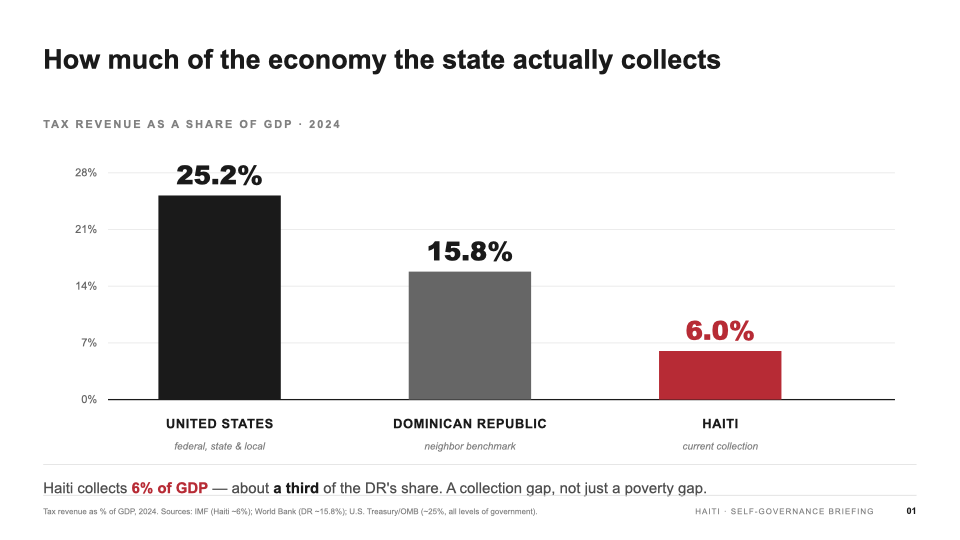
Slide 1: The state is collecting too small a share
Figure 1. Tax revenue as a share of GDP (Haiti, Dominican Republic, United States), 2024.
Here is how I present this live: everyone in Washington says we need better collection. They are right. This slide proves it. Haiti collects roughly 6 percent of GDP. The Dominican Republic is around 15.8 percent. The United States is around 25 percent across all levels.
Now the pivot: if we stop here, we still do not understand the operating reality. Share-of-GDP is a useful metric, but not the metric that determines whether a state can function per citizen.
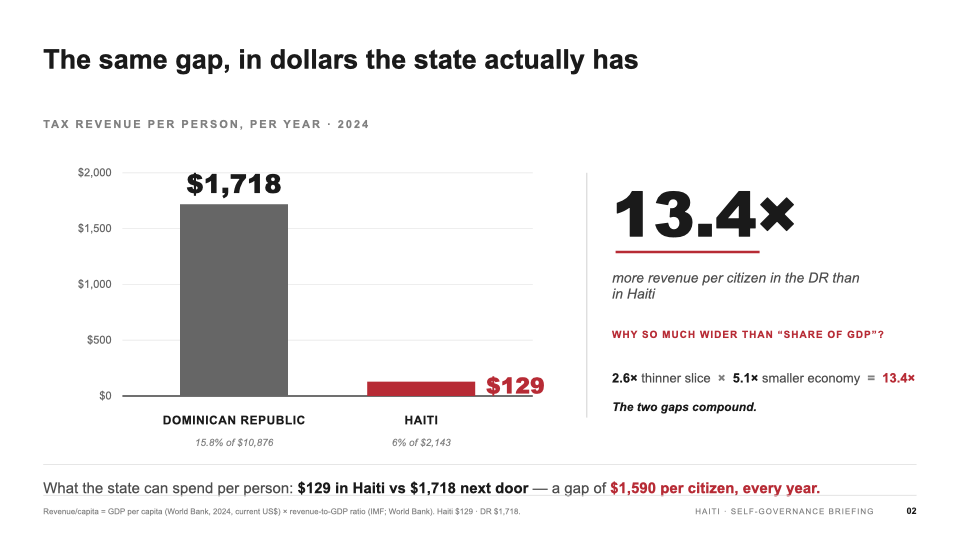
Slide 2: The gap that governs real life is per person
Figure 2. Tax revenue per person per year, showing the 13.4x per-capita revenue gap.
This is where rooms go quiet. Haiti is around $129 per person in state revenue. The Dominican Republic is around $1,718. That is a 13.4x difference.
This is not just a budget table. This is the money for courts, police payroll, roads, utility maintenance, and municipal service continuity. This is the difference between a state that can absorb shocks and a state that cannot.
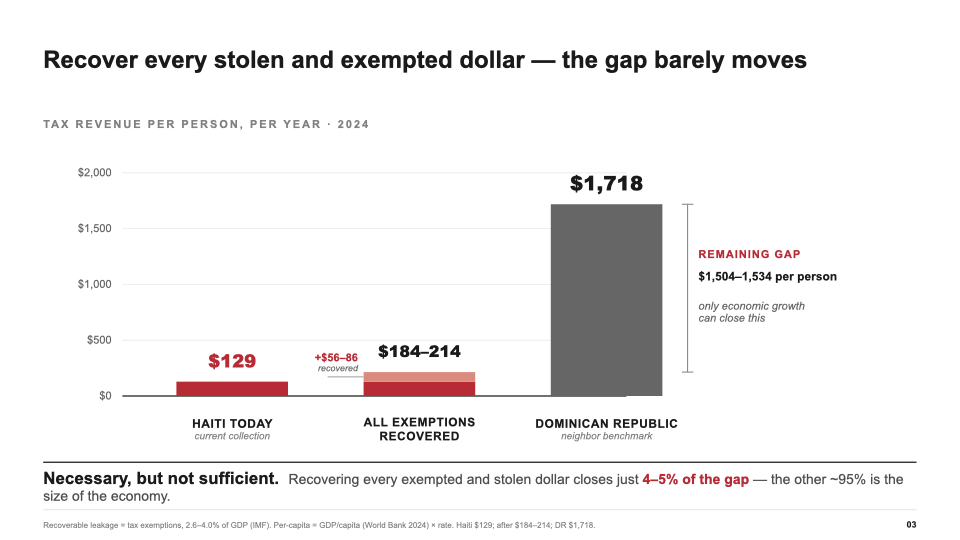
Slide 3: Even perfect anti-leakage leaves most of the gap
Figure 3. Modeled impact of recovering exemptions and leakage, with remaining per-capita gap.
Here is the first objection I always hear: "If we just recover stolen and exempted revenue, does that close the gap?"
Answer: do it anyway. It is necessary. But even in aggressive scenarios, it only closes a small share of the per-person gap. Anti-corruption is mandatory. Anti-corruption alone is insufficient.
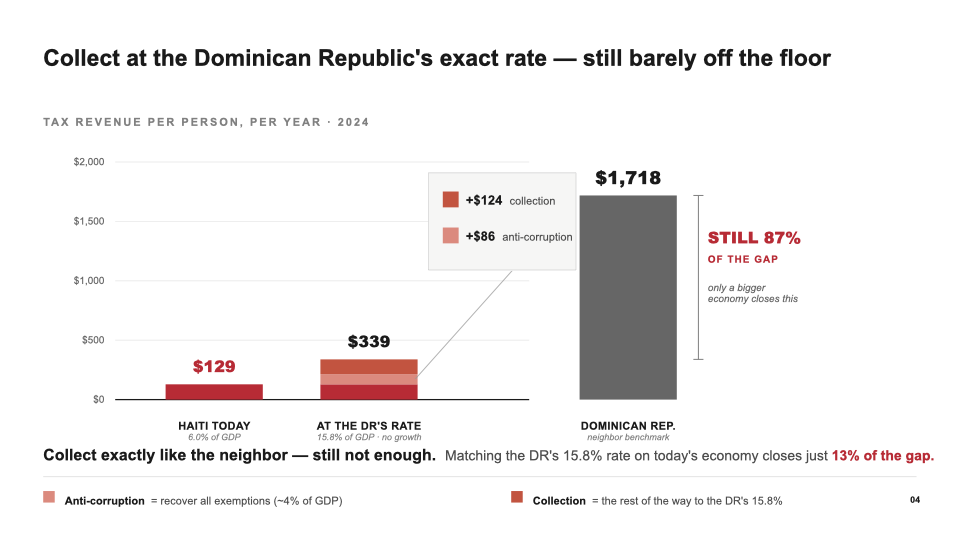
Slide 4: Match the Dominican rate and you still have a base problem
Figure 4. Collection-at-DR-rate scenario on today's economy still leaves most of the gap.
Now push the argument harder. Say Haiti collects at Dominican-level efficiency on today's economy. The gap still remains too large.
That is the point of this slide: this is not a rejection of reform. It is a rejection of reform-only thinking. You cannot tax your way out of a base that is too small.
Slide 5: Same governing burden, radically different tax base
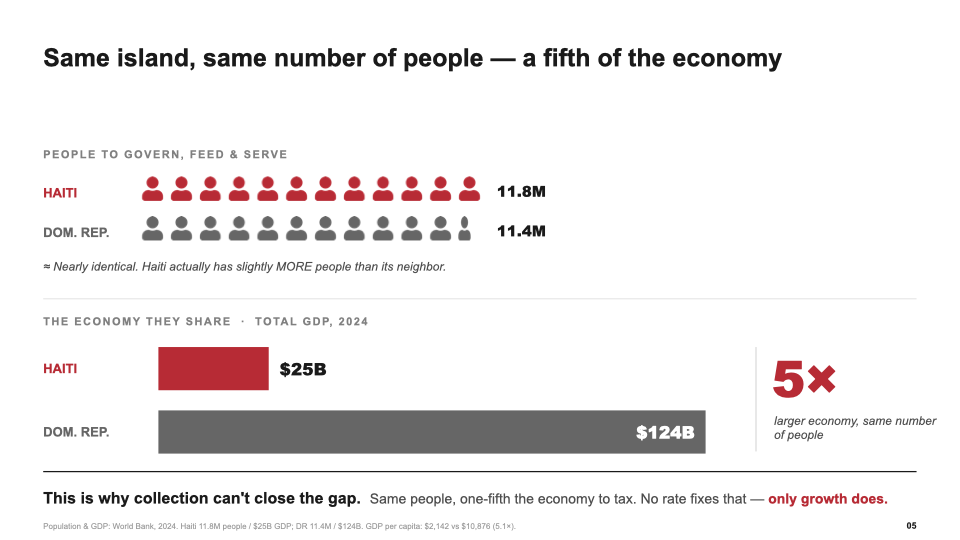
Figure 5. Population and total GDP comparison: Haiti vs Dominican Republic.
Put population and GDP side by side. Similar headcount burden. Very different productive base.
This is the trap: Haiti has roughly the same number of people to govern as its neighbor, but a much smaller economy to finance that obligation. If growth is absent, every policy cycle collapses back into emergency management.
Slide 6: Growth is the heavy lift, governance improvement multiplies it
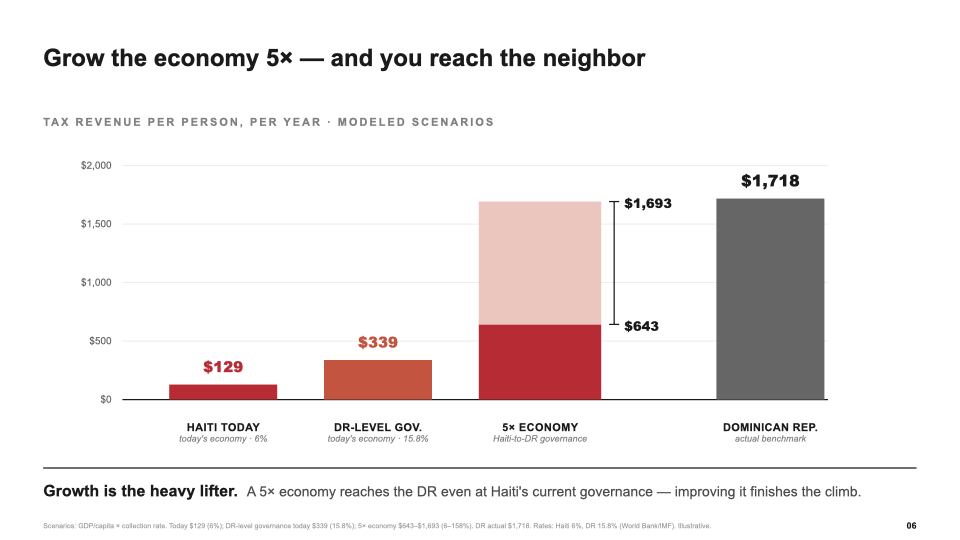
Figure 6. Revenue-per-person modeled scenarios under growth and governance assumptions.
This is where strategy gets real. Growth does the heavy lift. Governance improvement multiplies it.
If growth does not happen, no collection model reaches durable state capacity. If growth does happen but governance does not improve, gains leak. So the sequence is parallel, not serial: integrity, collection, and productive expansion at once.
Slide 7: Ground the policy asks in operators, not conference language
Figure 7. Survey audience used for policy design: business leaders, private equity, and trade partners.
At this point in the deck, I stop talking in aggregate and start grounding the case in operator interviews across manufacturing, logistics, finance, and investment.
These are not armchair analysts. They are people carrying daily exposure to customs leakage, corridor coercion, cash-distribution failure, recapitalization barriers, and real hiring decisions.
The question was simple: if level-one security is real, what do you need first to build now, not in theory?
Slide 8: Customs is the first lever because it hits both revenue and fairness
Figure 8. Customs reform stack: pre-shipment valuation, digital handling, and ring-fenced duty flows.
The strongest consensus ask was customs, and the language was specific.
One manufacturing operator described a market where legal operators are structurally penalized: about $2,000 in gang toll burden per container in high-pressure routes, plus systematic under-valuation dynamics that let informal channels undercut compliant importers.
Another operator framed the same distortion differently: competition in Haiti too often reflects the ability to defer state rules, not productive efficiency.
That is why the sequence here is non-negotiable:
- Pre-shipment valuation before departure.
- Digital handling to reduce discretionary rent points.
- Ring-fenced and auditable duty flows.
This is a two-way reform. It protects state revenue and restores fairer competition for businesses trying to comply.
Slide 9: Port reform fails if the border bypass stays open
Figure 9. Border/port routing logic and enforcement implications for revenue and security.
This is the enforcement companion to slide 8. If Haiti-bound goods can bypass effective customs pathways, port reform becomes theater.
Interview evidence tied this directly to fiscal leakage and security degradation. The same weak channels that erode duty collection are also channels for coercive rents, contraband routing, and criminal finance.
So this is not a choice between revenue policy and security policy. It is one policy problem.
Slide 10: Build power where payment discipline already exists
Figure 10. Payment-assured power architecture and the gas-import terminal enabling role.
Energy was the second major cluster. One interviewee's point was practical: if the public utility cannot reliably collect, every additional megawatt can deepen treasury stress unless you redesign payment architecture.
So the starting point is payment-assured demand: industry, banks, airport operations, and government nodes that already pay very high diesel-equivalent rates. Build from cash-flow certainty, then branch outward.
That creates a financeable bridge from expensive self-generation toward broader system confidence. The enabling move in the deck was infrastructure that supports lower-cost fuel and scalable generation economics.
Slide 11: Restart dormant capacity faster than building from scratch
Figure 11. Fast-restart concept: reactivating existing firms with war-risk de-risking tied to rehiring.
Final point in the deck: speed matters.
One investor interview track and related operator testimony pointed to the same issue: restarting proven operators can move faster than waiting for greenfield confidence.
These firms often retain execution memory, supply-chain relationships, and workforce pathways. What blocks them is not intent alone. It is risk asymmetry after repeated shocks.
That is why de-risking instruments tied to reopening and rehiring can outperform waiting for ideal conditions that may never arrive on schedule.
What the full deck says when read as one argument
Taken together, the slides argue for a disciplined sequence:
- Acknowledge the true fiscal gap in per-person terms.
- Reject anti-corruption-only and collection-only illusions.
- Treat growth as core state-capacity policy.
- Start with high-leverage implementation levers: customs, border enforcement, payment-disciplined energy, and restart of proven operators.
In plain terms: Haiti cannot collect its way out of an output deficit. It must grow its way out, while repairing the institutions that prevent that growth from being captured and drained.
What named operators actually converged on
The interview set was not consensus theater. There were real differences in tone and sequencing. But five cross-cutting constraints repeated across the group.
- Customs dysfunction is first-order, not peripheral.
- Border and port leakages punish compliant business and starve state revenue.
- Cash-logistics collapse has become a macro constraint.
- Proven operators can restart faster than first-time entrants if risk is partially de-risked.
- Informal market channels are a transition reality, not a policy footnote.
The strategic sequence
The sequencing problem in Haiti is often framed as security first, economy second. The interviews and meeting discussion point to a different model: security and economic restart must run in parallel, with each reinforcing the other.
A practical sequence for the first 12 to 24 months looks like this.
1) Fix customs first
If policy leaders want one high-leverage move that improves both fiscal capacity and market fairness, customs is the front door.
Multiple operators converged on mechanism, not slogan: pre-shipment valuation, digital process integrity, and ring-fenced revenue handling.
This is not abstract anti-corruption language. It is an answer to a daily operating distortion where compliant firms absorb full burden while bypass channels gain pricing advantage through under-valuation and informal routing.
2) Close the back door
Port reform fails if goods for Haiti continue to route through weakly controlled land pathways that defeat valuation and duty enforcement.
The policy implication is straightforward:
- Enforce by-sea entry rules for Haiti-bound commercial imports.
- Tie customs reform to corridor and border enforcement.
- Align revenue protection with arms and contraband interdiction.
This is one of the few interventions where fiscal and security objectives are naturally aligned.
3) Rebuild power around paying demand
The energy interviews were specific on structure: Haiti cannot keep deepening a public-utility deficit where non-collection socializes costs while productive users self-provision at extreme prices.
A practical path is to start with customers already paying high diesel-equivalent rates:
- Industry
- Financial institutions
- Airport and logistics users
- Government complexes with payment capacity
Then expand outward from payment-assured nodes.
The U.S.-linked enabling piece discussed in the slide deck was clear: lower-cost generation at meaningful scale requires import infrastructure and bankable commercial architecture, not isolated pilot rhetoric.
4) Restore cash circulation as infrastructure
One financial-services interviewee described this with unusual clarity: when upstream cash provisioning breaks, transfer networks can still exist on paper while liquidity dies in practice.
The synthesis work mapped this as a concrete network failure: roughly 120 of 540 points cut off in the severe phase, with cascading effects on remittance usability, local trade velocity, and rural transaction confidence.
So this is infrastructure work, not just finance work:
- Reopen secure cash logistics to regional hubs.
- Stabilize branch and sub-agent liquidity.
- Expand trusted digital rails in parallel, not as a fantasy overnight replacement for cash.
5) Bring back businesses that already worked
A recurring interview signal was that restart is faster through dormant proven operators than through first-time entrants unfamiliar with local execution realities.
Many firms were not destroyed because their business model failed. They were disrupted by compounded security and extraction risk. That distinction matters.
A de-risking architecture can be structured around:
- Partial guarantees tied to reopening and rehiring.
- Political and war-risk coverage linked to performance milestones.
- Co-investment design that shares downside without socializing private upside indiscriminately.
The principle is simple: recapitalize productive capacity, not passive rent extraction.
The governance reality
None of this works under a governance fiction that assumes technical fixes will self-execute in a political vacuum.
The interview set repeatedly identified a hard constraint: extraction chains are networked. They involve actors across public office, local coercive power, and commercial channels. Any reform that threatens rents will face organized resistance.
That does not make reform impossible. It means reform design must reduce opportunities for extraction at the system level rather than merely punish individuals after damage is done.
In operational terms, this favors:
- Fewer opaque chokepoints.
- More machine-readable transactions.
- Publicly auditable flows.
- Trigger-based financing tied to observable compliance.
The informal economy is not the enemy
One of the most useful findings from the interviews was this: informal commerce is currently a resilience channel, not simply a policy failure.
That does not justify informality as an end state. It means policy that ignores it will fail in the period that matters most.
A realistic transition logic is:
- Stabilize liquidity where people already transact.
- Build trust and payment history through usable rails.
- Formalize progressively through service exchange, not coercive fantasy.
One operator warning matters here: do not confuse transition realism with permanent informality. Stabilize flows first, then formalize through reciprocal service contracts and enforceable fairness.
Property, collateral, and municipal sovereignty
Another recurring operational point was that unresolved title and fragmented urban land systems trap household capital and suppress lending.
A phased strategy, zone by zone, can convert dead asset value into productive collateral while strengthening local service contracts.
One interviewee's implementation advice was explicit: do not attempt all zones at once. Pilot one settlement, prove title-to-service reciprocity, then scale.
In practice, that means tying formalization to reciprocal delivery:
- Registry and title clarity
- Utility access
- Municipal service enforcement
- Basic payment traceability
This is not just a technical cadastre question. It is state legitimacy at street level.
Elections and timeline realism
Interview perspectives diverged on timing, but converged on one risk: if political deadlines outrun institutional readiness, policy credibility will degrade quickly.
One manufacturing operator warning should remain on the table: an accelerated election under incomplete territorial control can produce procedural transition without durable legitimacy.
The practical way through is phased activation tied to measurable security and administrative benchmarks, not symbolic declarations.
That reduces the probability of loading large capital commitments into governance conditions that cannot yet hold.
What U.S. policy can actually do
The least useful recommendations are generic calls for “more support.” The most useful are implementable and conditional.
A focused U.S.-aligned package should include:
- Customs modernization support tied to transparent pre-shipment and ring-fenced collection architecture.
- Border and corridor enforcement cooperation aimed at both revenue integrity and illicit-flow disruption.
- Energy restart support that prioritizes payment-assured nodes and scalable lower-cost supply logistics.
- De-risking facilities for proven operators with strict reopening, employment, and compliance covenants.
- Cash-logistics and digital-finance support that restores market function in provincial corridors.
- Public transparency standards for externally supported economic programs, including disbursement traceability and independent verification.
And one non-negotiable guardrail: customs modernization must not become cover for opaque sovereignty transfer. Any private customs concession framework should be fully disclosed, publicly auditable, and explicitly constrained so core state revenue authority is not quietly privatized through nontransparent long-duration contracts.
The hard lesson from the last cycle
Haiti has seen ambitious pledges, sophisticated language, and high-level conferences before. What repeatedly failed was not diagnosis alone. It was execution architecture, incentive alignment, and continuity under pressure.
The post-2021 collapse reinforced that lesson.
If a new window opens, the decisive variable will not be how many strategic documents exist. It will be whether policy leaders can operationalize a short list of hard reforms quickly enough to change daily economic behavior before predatory structures reassert full control.
A practical doctrine for the next phase
The doctrine can be stated plainly:
- Do not wait for perfect governance to begin economic restart.
- Do not deploy capital without anti-extraction design.
- Do not confuse security activity with recovery policy.
- Do not treat informal systems as expendable during transition.
- Do not separate fiscal recovery from market-function repair.
Security can create the opening. Only growth can keep it open.
Closing
The June work made one thing unmistakable. Haiti's fiscal weakness is not only a story of corruption, or collection technique, or temporary insecurity. It is a story of insufficient productive scale under severe governance distortion.
That is why economic development in Haiti is not a side track to political stabilization. It is the load-bearing track.
If we act as though growth can wait, we will finance another cycle of crisis management.
If we build recovery architecture now, tied to transparency, competitive fairness, and executable local mechanics, then a level-one security moment can become a beginning instead of another intermission.
That is the choice in front of us.